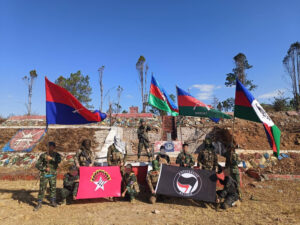
 Members of allied anti-junta militias pose following their victory in the battle of Falam in Spring 2025. From left to right, the displayed flags represent (top row) People’s Defense Force – Zoland, Chin National Organization, Chin Defense Force – Mindat, Chin National Defense Force, (bottom row) Anti-Fascist Internationalist Front, and Anti-Fascist Action.
Since a 2021 military coup initiated by the Tatmadaw (state armed forces) shattered a short and historically unprecedented period of civilian rule in Myanmar, the country has been embroiled in a bloody civil war. Nearly 100,000 people have been killed in the conflict so far and more than 3 million have experienced displacement.
Armed groups opposing the new military junta, ranging from ethnic militias to student and worker organizations, have largely consolidated under the People’s Defense Force (PDF) and align with the National Unity Government (NUG), the latter being composed of exiled members of the Myanmar parliament.
Enter into the fray a small but dedicated cadre of self-described revolutionary internationalists operating as the Anti-fascist Internationalist Front (AIF). These foreign fighters are not mercenaries but politically committed freelancers who cut their teeth on the battlefield in North East Syria (in Kurdish: Rojava) serving in the militias of the Syrian Democratic Forces (SDF).
Though I maintain my own political and strategic differences with the AIF, I am hopeful that the analysis and rationale presented here might serve as a provocation for an international socialist left that has so far remarked little on the civil war in Myanmar.
1. First, could you tell me about yourself?
I am H., a member of Anti-Fascist International Front (AIF) from California. I have previously participated in the revolution in Rojava and now find myself in the works of the revolution in Myanmar. My primary responsibility in the AIF is in the political commission.
2. The civil war and revolution in Myanmar has received relatively little attention when compared to other recent conflicts, why do you think this is?
It is not surprising that our comrades in Myanmar remain neglected by the global mainstream in each of its colors. Myanmar has been pressed to the very bottom of international consideration throughout its history. The region is on the periphery of the global periphery, tucked between the marginalized extremities of northeast India and the isolated frontiers of Laos and Thailand, sharing just enough of a border with the Chinese state to get occasional attention from its oligarchy. Following World War II, the last colonial gaze at the eastern edge of British occupation gave way to failed CIA anti-communist operations in the north of the country, desperately scrambling for a new puppet regime which never manifested.
In recent times, Western eyes have been drawn north of the Andaman Sea mostly for the political plight of imprisoned Nobel Laureate Aung San Suu Kyi, and the profitable trauma porn of the Rohingya genocide. Aside from brief mentions of the coup and youth-driven uprising dominated by the occasional article from BBC or al-Jazeera, the Western sphere has seen little use in acknowledging Myanmar.
The current phase of the revolution in Myanmar began after the coup d’etat in 2021, during which the Burmese military overthrew the preeminent National League for Democracy after many years of grappling for political power within the state. While this phase of the resistance has been its most intense and decisive in decades, the war for liberation from the Burmese military has existed in many areas of Myanmar ever since the state’s independence, and even previous to this, frequent wars of self-defense from the communities of the margin against the coercive Burmese kingdoms of the lowlands for centuries. So we see in this stage of the revolution not just a fight against a coup, but the manifestation of centuries of self-defense against the central power structures of the Burmese state. This revolution thus has an unprecedented opportunity to completely overhaul the state’s coercive foundations, and in it there exists a basis for internationalist praxis. I will not repeat so much of what has already been spoken by many comrades from Myanmar already, as any understanding of the revolution’s timeline and preconditions can and should be sourced from the many local perspectives that are not our own.
3. The AIF is a recent formation, announcing its presence in Myanmar in late 2024. What is the AIF? What are its aims? Where does it have a presence and what activities does it undertake?
The Anti-Fascist Internationalist Front was formed just before the Battle of Falam by international comrades in cooperation with our allies in the Chin Hills to directly support revolutionary developments in Myanmar, and also as an internationalist structure inspired by the paradigm of democratic modernity and the Kurdish freedom movement.
The AIF operates in multiple regions of Myanmar and our comrades go where their responsibilities are most needed. Since its foundation, the structure has played a role in the liberation of Falam, maintaining a militant presence both on the frontlines and in the rear lines, while also holding trainings for our allies.
We are antifascist, but to us this is something that goes beyond just confronting fascism. All of our practical work is predicated on communal development and ideological struggle. We see little meaning in handling a weapon without this social and political foundation in our work. We would not and cannot exist without it. So, while we are a military structure, our daily works are not exclusively military. Our work is equally political, diplomatic, social, and our program is organized accordingly.
We fight alongside our comrades here for a world free of domination, and that is what our struggle is predicated upon. Working together not just with the existing organizations but also with local women in their pursuit of autonomy and liberation is a major part of our responsibilities here as internationalists. Our struggle is thus not just an externalized object that comes out of a gun, it is something that begins in each comrade’s heart. Liberation struggles both within and around us, from the individual to the constellations of global society.
So, the future of the organization will flow with this collective struggle and operate according to the necessities of the revolution. Our energy will continue to be exacted against the prevailing domination of the junta until its demise. Meanwhile, our struggle of revolutionary development continues regardless of the surrounding conditions, both in Myanmar and abroad.
4. As a U.S. citizen, what motivated your decision to travel to Myanmar and take up arms?
For me personally, I was organizing with comrades of the Myanmar diaspora for some time, and comrades in the community encouraged me to go forth in joining the struggle at the source. So when it became possible for me to do so, I did. Having engaged with revolutionary movements and struggles across the international front, comrades have found an opportunity for me to bridge further solidarity with other comrades and communities in the world. It made a lot of sense to contribute to the revolution here in this way.
In my perspective, the revolution in Myanmar takes on a number of internationalist responsibilities. One of them is owed to my generation, Gen Z, which has initiated much of the current phase of this revolution. Our Gen Z comrades here have found no time to waste in seizing revolutionary responsibility, and they have done so very well. Any internationalist must not neglect the sacrifices our Gen Z comrades in Myanmar make to realize liberation. For internationalist comrades of Gen Z, there is a particular global urgency that ought to be known and internalized by the inspiration our comrades here are creating. It is your responsibility to carry this fire as well, dear comrade.
Another major factor for any internationalist to consider, which also holds a role in my decision to struggle here, is the Israeli state’s deep and longstanding investment in the junta. The Israeli state designed the Burmese military’s weapons, supplies parts for its aircraft, and maintains a not-so-visible economic partnership. Though it may not be obvious, this struggle is absolutely a major front against Israeli imperialism in Asia.
Nonetheless, our presence here does not have to be justified by how close or how distant our immediate enemy is to Israel, as the struggle of internationalism is not simply a game of power structures. The global resistance against genocide is just as political and social as it is material, and this entails a vast range of internationalist responsibilities. While the genocide in Palestine has been the primary driver of internationalist organizing recently and very rightly so, it is important to consider that Israel is not the only state actor committing genocide in the world right now.
5. How do you conceptualize internationalism? Why, for you, does it necessitate participating as an armed combatant?
It is a reality that the spectacle of war gains attraction from the consuming and extracting forces of the neoliberal order, and even so, there is so much marginalization of Myanmar from global power systems that even war is not enough of a spectacle for much of the neoliberal order to bat an eye.
Yet, our presence here is also an immediate defense against the opportunism of the states that we were born under. The scramble to control the jade mines of Kachin region, for example, is an active flashpoint in which the US and Chinese state are competing with one another, far away from the global spotlight. There are lobbies connected to both respective ruling classes whose full time responsibility is to monitor and act upon opportunities to extract from Myanmar, almost exclusively through cooperation with the junta.
Our relationship with war intends to dispel and subvert the liberal hypothesis of simply going and helping because people are suffering, and then to feel morally validated. There is no transaction to our work here. I would argue that our practical work is hardly even deployed here because of war, but rather because of the immediate necessity of defense against genocide. The interconnectedness of this revolution with the realities of many other communities in self-defense, as well as the intersecting powers of the global system that allow a broader force of the enemy to develop here, necessitate an active internationalist consciousness for and within this revolution.
The paradigm of democratic modernity teaches us a significant concept as it pertains to revolutionary people’s war: the wextê alozî (chaos interval). This is a volatile period in any society within which there is a finite window of opportunity for a high degree of revolutionary change. The 2021 coup created this wextê alozî for the communities of Myanmar in which we are currently struggling, and it is directly connected to how we approach internationalism.
As a structure, we have been invited here by local revolutionary movements with whom we work closely, and it is on this basis of direct cooperation that we engage in revolutionary work. Within this wextê alozî, we are guided by the immediate needs of local comrades here, and we do not intend to insert ourselves into an environment that we predefine from the outside. We navigate it through struggle and adjustment, not self-validation.
It is crucial to consider that the revolution in Myanmar is not a political monolith. Some may confuse liberal forces for being the primary political force because they have been able to communicate most conveniently and effectively with bourgeois power systems in the Global North. The political reality on the ground here is more complex and messy. No political force has a real hegemony in the revolution, which means it is broadly decentralized.
As anti-fascists, it is easy for our eyes to look directly toward the leftmost formations in the revolution, but only looking where our eyes move most easily denies us of understanding the broader picture. Our communist comrades in the Communist Party of Burma hold their own umbrella of revolutionary forces while socialist-adjacent groups such as Bamar People’s Liberation Army and Buffalo Soldier Freedom Force all frequently cooperate on the basis of shared principles. But, this does not stop them nor does it stop us from fighting alongside more populistic forces like the National Unity Government or Kachin Independence Organization. In Myanmar the revolution takes the form of a united front against the fascist junta, and it is for a future where communities can determine their own realities without the immediate threat of genocide. What that future looks like is not for us to determine, but we are willing to give our lives to defend the opportunity for communities here to determine it themselves.
A Kurdish comrade in the People’s Protection Units once said during the defense of the Tişrîn Dam: “If the PKM doesn’t work, the BBC won’t talk about us, friends! You need to understand — if this doesn’t work, no one will even acknowledge us. If this fails, our language will vanish. Our traditions will be erased. If this fails, our cemeteries will be desecrated. If this fails, our mothers will be left defenseless. But if we have this, we have everything. Without it, I swear to you — nothing will remain. Ourselves won’t remain. They will take us out one by one.”
6. What is your relationship to the citizens of Myanmar who you’ve embedded alongside? Do they share your internationalist perspective?
Until the AIF, most foreigners in the Chin Hills had either an overtly transactional or extractive relationship with local communities. We come here asking for nothing, and this is a strange thing to see for a community that has been subjected to a cocktail of British colonization and American evangelism.
We don’t barge into the hills acting like we own the place. Our internationalist praxis here begins in asking what we can do as internationalists to deepen the defense against the junta and expand connection with other comrades in struggle across the world. Internationalists in AIF hold a particular responsibility in bridging solidarity with the communication we have developed on the international front, this is a major piece of our political work.
It is worth noting that this solidarity has also already been expressed in the revolution without our help in various ways. Karenni National Defense Forces comrades in the east of the country have expressed solidarity with the revolution in Rojava, for example. Women comrades of the Chin National Defense Forces, on their own initiative, have exchanged messages of solidarity with the autonomous women’s forces of Rojava. We work to initiate more cooperation with democratic forces in the world to deepen and expand this kind of
solidarity on a more practical basis.
Crucially, internationalism is in the struggle for women’s liberation and does not exist without it. The struggle against 10,000 years of patriarchy is just as real in the Chin Hills as it is anywhere else in the world, from the subtleties of established gender roles within the revolution to the overt patriarchal violence committed by the junta. In international connection between women’s movements there exists a new seed for women’s liberation to blossom. We are thus here to facilitate a broader people’s diplomacy that actively allows space for the local women’s struggle to deepen.
How we struggle against patriarchy within our structure directly relates with how we interact with patriarchy in internationalism, within local society, and the structures of our allies. We have, for example, created a program for men in the unit to deconstruct patriarchal tendencies and apply this deconstruction in our interactions with society. As an integral praxis of internationalism, we intend to contest in our daily life the patriarchal norms legitimized here by imperialistic forces, whether coming from Yangon or London or Ohio.
7. Where can people learn more about the situation in Myanmar and the AIF?
Organize with local Myanmar diaspora communities and simply include Myanmar in your internationalist praxis, whatever that may look like in your locale. We encourage comrades to organize solidarity events involving the revolution in Myanmar and the AIF. We are happy to support these events and participate in Q & As. Do not let our revolutionary comrades in Myanmar be silenced.
You can find the AIF’s blog here: https://aifmyanmar.noblogs.org/
You can also find more regular updates from AIF on our Instagram: https://www.instagram.com/aifmyanmar/